Put YouTube videos
to work

Give your agent a video and a task. Get a plan with timestamps, not a summary.

For Pi, Codex, and Claude Code.

Already set up? Try your first video

Builders

Simplify my agent architecture

Start with an environment, tools, and a prompt.

See the plan & sources

Suggested next steps

  1. Define the environment, available tools, goals, and stopping conditions.
  2. Start with one model–tool loop. Inspect the feedback each tool returns.
  3. Test representative tasks before adding routing, memory, or parallel agents.

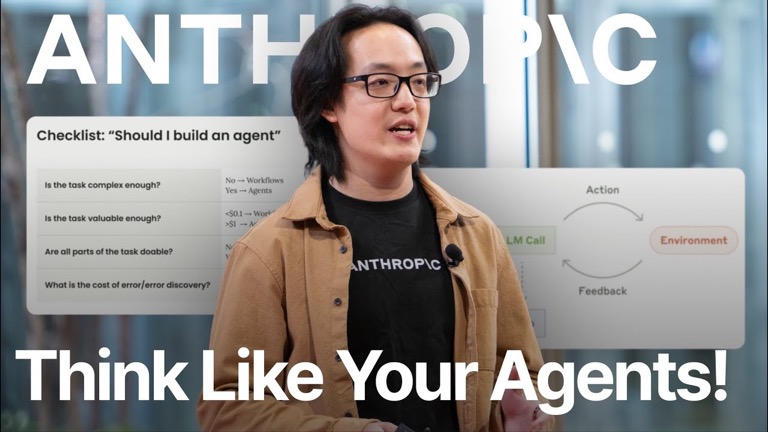
How We Build Effective Agents: Barry Zhang, Anthropic

They're models using tools in a loop. 5:46

any complexity up front is really going to kill iteration speed. 6:18

Selected search passages about simplicity, tools, and agent loops; not the full talk. Automatic captions; may contain errors.

Choose my agent’s sandbox

Compare isolation, GPU needs, and snapshot/restore.

See the plan & sources

Suggested next steps

  1. Define what untrusted code must not access: host data, credentials, and network destinations.
  2. Compare isolation boundaries, GPU support, and I/O costs for your workload.
  3. Prototype snapshot, execute, and restore. Verify state recovery and cleanup with a failing task.

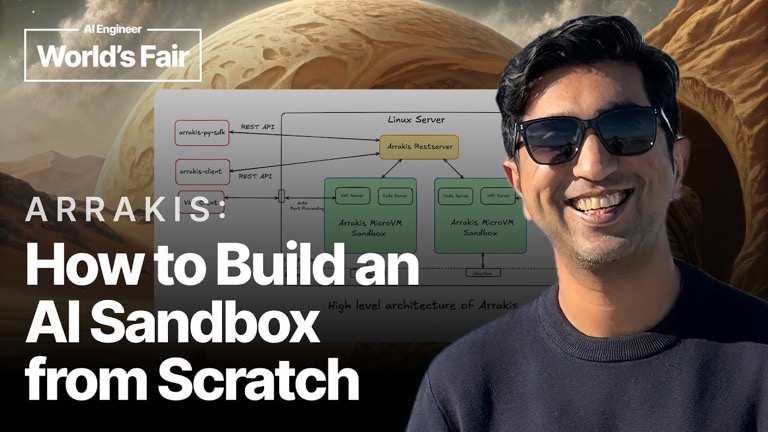
Arrakis: How To Build An AI Sandbox From Scratch - Abhishek Bhardwaj, OpenAI

each VM has its own guest user space and guest kernel. 14:34

you do get GPU access more easily in G Visor and containers versus like microVMs 23:22

Selected passages on isolation, security trade-offs, and snapshot/restore. The search bundle was budget-limited; not a full architecture review. Automatic captions; may contain errors.

Shrink context without losing it

Keep bulky results in files, paths in context.

See the plan & sources

Suggested next steps

  1. Persist bulky results; keep paths so the agent can retrieve the originals.
  2. Compact older calls first. Retain recent complete tool examples.
  3. Evaluate task success and missing-field errors before turning to lossy summaries.

Context Engineering for AI Agents with LangChain and Manus

drop the super long content field and just keep the path. 15:54

we still like keep the last few tool calls and tool results in full detail 18:47

Chapter 4, Context reduction in Manus, read completely. Adjacent overlapping caption cues included; not the full conversation. Automatic captions; may contain errors.

Business

Stop relitigating team decisions

Write the decision down so the team can inherit it.

See the plan & sources

Suggested next steps

  1. Pick a recurring decision your team keeps reopening.
  2. Write a one-page note: options, rationale, owner, and a revisit trigger.
  3. Ask someone outside the meeting to explain the decision using only that note.

Patrick Collison — Why Silicon Valley's most talented should leave

I and lots of people write things in order to organize one's own thoughts. 1:29:28

The requested 1:29:02–1:34:02 window on Stripe’s writing culture and internal LLM tools, including overlapping caption cues. Not the full interview. Creator-provided captions; may contain errors.

Stress-test our startup’s moat

A rival can copy features, not your customers.

See the plan & sources

Suggested next steps

  1. List the features a well-funded rival could recreate with today’s tools.
  2. Identify customers and ecosystem relationships that a replica would still have to win.
  3. Try one customer-specific feature; check whether customers value it enough to stay.

Thrive Capital’s Miles Grimshaw: Why Software Moats Just Disappeared

Might not have any residents yet, but you can build that city. 57:24

companies now should say yes to like one customer's needed feature. 1:01:54

The requested 54:25–1:03:30 window on software moats and bespoke features, including overlapping caption cues. An investor’s thesis, not a verified forecast or full interview review. Creator-provided captions; may contain errors.

Make onboarding worth remembering

Invent an absurd first run, then ship one real delight.

See the plan & sources

Suggested next steps

  1. Pick one moment: a customer’s first successful use.
  2. Sketch a five-star, seven-star, and absurd eleven-star version.
  3. Work backwards to one affordable delight. Test it with a customer before scaling.

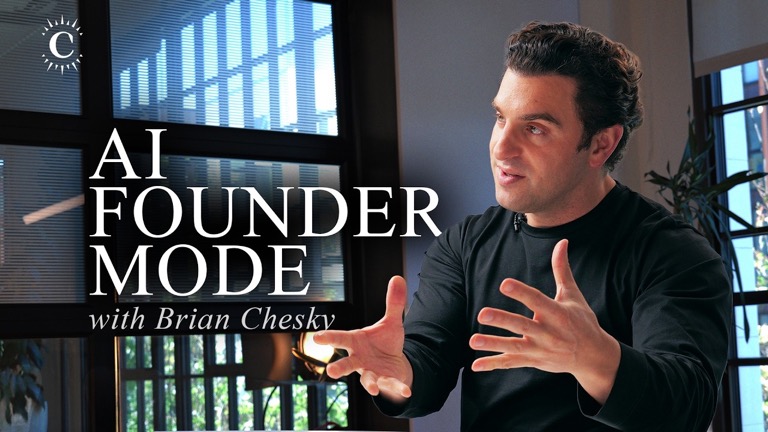
How Brian Chesky Is Redesigning Airbnb for the AI Era

you keep pushing to go so absurd to 10 stars that suddenly six or seven stars doesn't seem crazy at all. 39:16

Chapter 7, The 11-Star Experience, read completely. Adjacent overlapping caption cues included; not the full interview or a guarantee of product-market fit. Automatic captions; may contain errors.

Selected captions. Plans are our adaptations, not speaker instructions or full-video reviews.

Save once
Markdown + SQLite. Readable offline.
Search locally
Full-text search with SQLite FTS5. No re-download.
Read what matters
Timestamped passages, not a dump.

Retrieval is local. Your model may not be.

View setup instructions

Install ytmd using https://gvkhosla.github.io/ytmd/llms.txt. Read the instructions and installer first. Check dependencies, ask before making system changes, and install the CLI and skill for my agent. Verify with ytmd doctor.

Then restart your agent and give it a video URL and a task.

Prefer the terminal?
Try your first video

After setup, restart your agent. Paste this request, or replace the video and task with your own:

Help me simplify my agent architecture using this video: https://www.youtube.com/watch?v=D7_ipDqhtwk. Use ytmd to read relevant evidence. Explain the trade-offs and suggest one change to test. Cite timestamps, separate speaker claims from your adaptations, and say what you actually read.

Look for a proposed change, checkable timestamps, and an explanation of what was read—not a claim to have reviewed the whole talk.

Free and open source. Videos need available captions.